FREE LIVE WEBINAR FOR WOMEN WITH JANI WEIZMAN
The Moment Before You React
You understand why you react the way you do. But once the reaction begins, you still can’t stop it.
In this free 75-minute webinar, you will examine one recent reaction and write down what happened before you acted.
By the end, you will know what appears first for you: a thought, a physical change or an urge to act. This is the signal you will start watching for so you can pause before the impulse becomes a reaction.
With your partner, your child, your family or at work.
The live webinar has now taken place
Join the waitlist to hear first about the next live date or replay access.
Leave your email on the next page and we’ll be in touch when the next opportunity opens.
Everyone who attends live will receive a surprise digital gift from me.
Watch the invitation
In this short video, I explain why understanding a reaction afterwards does not stop you from repeating it.
Watch with sound on
What happens when you react automatically
With your partner
They seem distant, and you immediately think something is wrong between you. You keep asking what happened or insist on getting an answer. They stop responding or end the conversation. You wanted reassurance, but now there is more distance between you.
With your child
You have asked them three times, and they still are not listening. The fourth time, you shout. They react to the shouting, and you still have to deal with what they did. Later, you also have to repair the way you spoke to them.
At work
Someone questions something you did. You hear criticism and start defending yourself. Your tone becomes sharp. The other person starts responding to your tone instead of discussing your work.
With your family
Someone says something that hurts you. You stay quiet because you do not want another argument. They continue as though nothing happened. You remain angry because you did not tell them how their comment affected you.
In each example, the original issue remains unresolved. The other person is now responding to the reaction as well.
Let’s examine one of these situations
You are telling your partner that something they did hurt you.
While you are speaking, they pick up their phone and start scrolling.
You think, “They’re not even listening. What I’m saying doesn’t matter to them.”
Your chest tightens, your face becomes hot and the anger rises.
You feel the urge to make them put the phone down and listen.
You raise your voice and say, “You never listen to me.”
Your partner responds to the accusation. Now you are arguing about whether they “never listen.” You are no longer discussing what they did that hurt you.
The reaction did not begin when you raised your voice.
It began when your partner picked up the phone and you understood their behaviour as proof that what you were saying did not matter. Your body reacted, the anger rose and you felt the urge to make them listen.
The phone still needs to be addressed. The pause gives you time to say exactly what is affecting you before “You never listen to me” becomes the subject of the argument.
The Pause Map
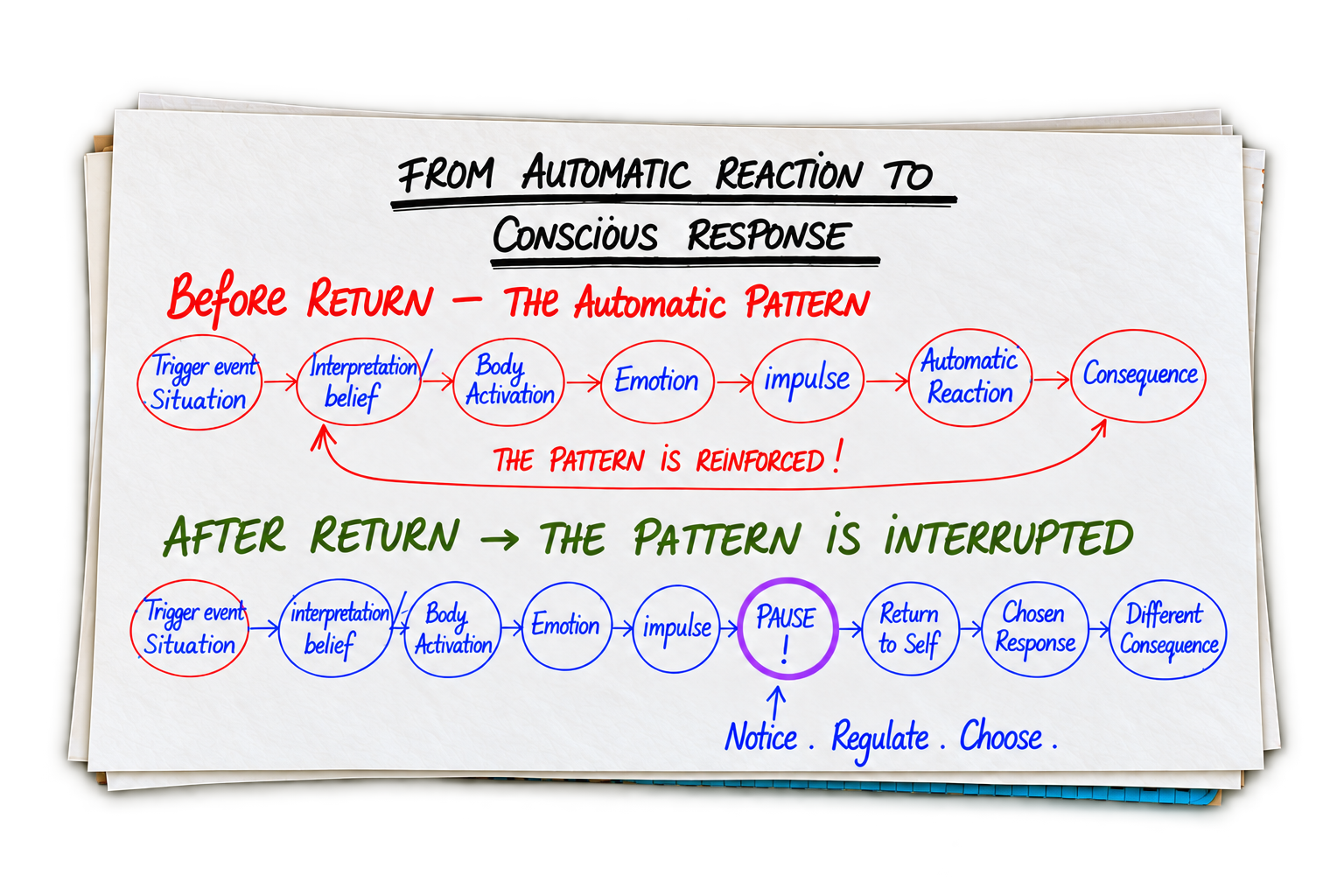
The Pause Map lists each part of the automatic reaction:
Triggering situation → Interpretation or belief → Body activation → Emotion → Impulse → Automatic reaction → Consequence
In our example:
Triggering situation: Your partner picks up their phone and starts scrolling while you are speaking.
Interpretation or belief: “They’re not listening. What I’m saying doesn’t matter to them.”
Body activation: Your chest tightens and your face becomes hot.
Emotion: Anger.
Impulse: You feel the urge to make them put the phone down and listen.
Automatic reaction: You raise your voice and say, “You never listen to me.”
Consequence: Your partner defends themselves against the accusation. You argue about whether they “never listen” instead of discussing what they did that hurt you.
Creating space before the automatic reaction
The pause happens after you notice the impulse:
Impulse → Pause → Return to yourself → Chosen response → Different consequence
You notice:
“I’m angry, and I want to raise my voice so they will put the phone down.”
You regulate enough to decide what you want to say:
“Can you put your phone down? I need you to listen to what I’m saying. If now isn’t a good time, tell me when we can talk.”
You address what is happening without saying that your partner never listens. Their response gives you more information about whether they are willing to have the conversation.
Thoughts, emotions and physical sensations often happen close together. The map lists them separately so you can identify what happens in your own reaction and where you can pause.
What we will do during the webinar
Bring one recent situation in which you reacted in a way you regretted or did not fully understand.
Choose something manageable. Leave the most painful experience for a setting where you have individual support.
I will guide you as you place your situation on the Pause Map. Then you will identify the earliest part you remember.
The first signal differs from person to person. Some women first notice a change in their breathing. Others notice a tight jaw, heat in the face, a familiar thought or an urgent need to act.
You will identify your own signal and start paying attention to it in daily life.
We begin with a manageable situation because breathing, grounding and pausing are harder to use when the emotion is already at full intensity. At that point, clear thinking and impulse control require much more effort.
You can keep your camera off, stay on mute and complete the exercise privately in your notebook. You do not have to share your situation with the group.
At the end of the webinar, you will have your own Pause Map and one specific signal to watch for the next time a reaction begins.
The optional live Q&A starts afterwards.
Is this webinar for you?
This webinar is for women who understand their reactions afterwards and still repeat them.
You know why you shout, panic, withdraw or make certain decisions. You have thought about it, talked about it or worked on it in therapy. When the emotion becomes intense, that understanding does not stop the automatic reaction.
You want to recognise what happens before you react, while there is still time to choose your response.
No previous experience with breathwork, psychology or somatic work is required.
Bring a notebook and one recent situation that feels manageable to examine.
About me
I’m Jani Weizman.

I began my professional work with the body, through physical therapy, Pilates and yoga. Later, I trained in breathwork and guided hundreds of people through body-based practices.
Again and again, I saw people who understood why they reacted as they did, but still could not use that understanding when the emotion became intense. I wanted to understand what was happening in those few seconds before the reaction.
That question has shaped my work ever since. My background now includes psychology, integrative psychotherapy with ARPI, Somatic Experiencing®️ and Rebirthing Breathwork with Leonard Orr’s Rebirthing Breathwork International.
In this webinar, I will bring these different parts together and help you examine one of your own reactions from beginning to end.
“I spent years understanding why I reacted the way I did. The harder part was learning to notice it early enough to do something different. This is the work I now teach”
— Jani Weizman
Join the waitlist
The live session has now taken place.
Leave your email to hear first about the next live date or replay access. The Moment Before You React is a free 75-minute webinar with Jani Weizman.
You’ll be the first to know when the next opportunity opens.
Next live date to be announced
Join the waitlist now and we’ll keep you updated.
Leave your email on the next page to stay in the loop.
Complete the short form so Jani can let you know when the next session or replay becomes available.
Before you join
Is this only about romantic relationships?
No. You can examine a reaction involving your partner, your child, a family member or someone at work. The webinar is for women.
How long does the webinar last?
The webinar lasts 75 minutes. The optional Q&A starts afterwards. You can leave when the webinar ends or stay for questions.
Is this therapy?
No. This is an educational and experiential webinar. It is not psychotherapy, medical treatment, trauma treatment or crisis support.
Do I have to speak?
No. You can stay on mute and complete the exercise privately in your notebook.
Do I have to keep my camera on?
No. You can participate with your camera off.
Do I have to join The Return?
No. I will introduce the program briefly at the end. The webinar stands on its own, and you decide whether you want to continue.
The Moment Before You React
Next live date to be announced
Join the waitlist to be notified first.
The Moment Before You React · Free 75-minute webinar with Jani Weizman
JOIN THE WAITLIST →This webinar is educational and experiential. It is not psychotherapy, medical treatment, trauma treatment or crisis support.
If a relationship involves fear, threats, coercion or violence, safety and specialised support come first. Self-regulation does not make you responsible for another person’s harmful behaviour.
FIXED REGISTRATION BAR
The Moment Before You React
Join the waitlist for the next live session